- The Arts & Crafts Movement – an international design movement between 1866 and 1930 which sought to remove the distinction between “art” and “craft”. It stood for traditional craftsmanship using simple forms and often applied medieval, romantic or folk styles of decoration.
- Orphism – an offshoot of Cubism that focused on pure abstraction and bright colors, influenced by Fauvism and theoretical writings of Paul Signac.
- Rayonism – a style of abstract art that developed in Russia in 1911. Inspired by Cubism and Futurism, the movement sought an art that floated beyond abstraction, outside of time and space, and to break the barriers between the artist and the public.
- Suprematism – an art movement, founded by Kazimir Malevich in Russia, in 1915, that focused on basic geometric forms, such as circles, squares, lines, and rectangles, painted in a limited range of colors.
Friday, October 21, 2016
Terms of the Day for October 21

Wednesday, October 19, 2016
Slide Images for October 19

Pablo Picasso
Demoiselles d’Avignon (The Young Ladies of Avignon)
1907

Georges Braque
The Portuguese
1911

Henri Matisse
Red Studio
1911

Ernst Ludwig Kirchner
Street, Dresden
1908

Egon Schiele
Self-portrait
1912

Wassily Kandinsky
Composition VII
1913

Margaretha von Brauchitch
Embroidered Tablecloth
1901

Wassily Kandinsky
Concerning the Spiritual in Art
1912


Women’s Fashion Advertisements
1902, 1910

Duncan Grant (design)
Lady Ottoline Morrell (embroidery)
Firescreen
1912

Vanessa Bell
Cracow
1913

Wnifred Gill and Nina Hamnet modeling dresses at the Omega Workshops
c. 1913

Vanessa Bell
Virginia Wolf Knitting
c. 1912

Vanessa Bell
The Tub
1917
Terms of the Day for October 18
- Modern Art – artistic works produced during the period extending roughly from the 1860s to the 1970s, and denotes the style and philosophy of art in which the traditions of the past have been thrown aside in a spirit of experimentation.
- Abstraction – art which uses a visual language of form, color and line to create a composition which distorts traditional representations of—or exists with a degree of independence from—visual references in the world.
- Reform Dress Movement – a late 19th and early 20th century movement to reform constricting clothing designed for women and to transform the ideal female figure from Victorian exaggerated proportions to a more natural, “healthy” shape.
- The Omega Workshops – an experimental design collective founded by the painter and influential art critic Roger Fry in 1913, whose purpose what to bring the experimental language of avant-garde art to domestic design in Edwardian Britain.
Monday, October 17, 2016
Slide Images for October 17

Eva Gonzales
Morning Awakening
1876

Marie Bracquemond
Tea-Time
1880

Édouard Manet
Berthe Morisot
1874

Édouard Manet
The Balcony
1868-69

Berthe Morisot
Mother and Sister of the Artist
1870

Berthe Morisot
The Cradle
1872

Berthe Morisot
The Bath: Girl Arranging Her Hair
1885-86

Berthe Morisot
The Cherry Picker
1891

Edgar Degas
Portrait of Mary Cassatt
c. 1880-84

Edgar Degas
Mary Cassatt at the Louvre
c. 1880

Mary Cassatt
A Cup of Tea
c. 1880

Mary Cassatt
The Child’s Bath
1893

Édouard Manet
Gare Saint-Lazare
1873

Berthe Morisot
Psyche
1876

Berthe Morisot
Psyche
1876

Mary Cassatt
Mother and Child
c. 1905

Edgar Degas
The Pedicure
1873

Mary Cassatt
The Boating Party
c. 1893-94

Mary Cassatt
The Opera
1878

Mary Cassatt
Woman and Child Driving
1879
Terms of the Day for October 17
- Impressionism – a style of painting, developed in the late nineteenth century, that focused on casual subjects, the ability to paint outdoors, and divided brush strokes to capture the light and mood of a particular moment.
- En plein air – a French expression, meaning "in the open air", which is used to describe the act of painting outdoors. This became particularly important to the Barbizon school and Impressionism after the introduction of paints in tubes in the 1870s
- Bourgeoisie – a term used to designate the upper middle class, specifically in France. In the 19th century, the Bourgeoisie grew to prominence in France, establishing a culture centered around domestic models of family, leisure time, and an appreciation of the new industrialization of the modern Western world.
- Woman’s Gaze – a term which refers to the depictions of women as spectators. This is in contrast to a great majority of images in which women are depicted as merely spectacles.
Tuesday, October 11, 2016
Slide Images for October 10

Harriet Hosmer
Zenobia in Chains
1859

Harriet Hosmer
Beatrice Cenci
1856

Edmonia Lewis
Forever Free
1867

Edmonia Lewis
The Death of Cleopatra
1876
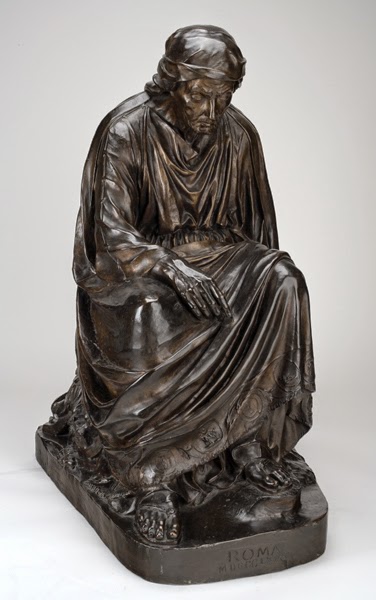
Anne Whitney
Roma
1869

Jennie Brownscombe
The New School-Mistress
1876

Susan MacDowell Eakins
Portrait of Thomas Eakins
1889

Alice Barber Stephens
The Female Life Class
1879
Terms of the Day for October 10
- "The White Marmorean Flock” – a group of American women sculptors who studied and worked together as a collective in Rome in the mid- to late-19th century. The title of the group was a pejorative name developed by author Henry James which the women decided to adopt.
- The First-Wave Feminism – a period of feminist activity during the 19th and early twentieth century, particularly in the United Kingdom and the United States. It focused on ending officially mandated inequalities and gaining women's suffrage.
- The Centennial International Exhibition – the first official World's Fair in the United States, held to celebrate the 100th anniversary of the signing of the Declaration of Independence. It is notable for a “Women’s Pavilion,” which displayed a wide range of work by women artists and artisans.
Subscribe to:
Posts (Atom)